
Flashback: Softstar Shoes Takes 1985 by Storm
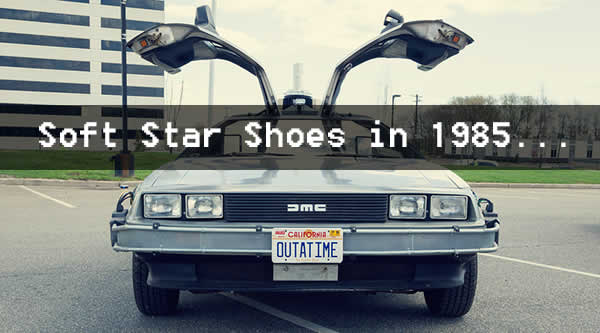
Ready for a little trip back to the days of jean jackets, Rubik's cubes and Max Headroom? Crank your DeLorean up to 88, because here we go ...
Softstar founder Tim Oliver recently came to me holding an overflowing folder he found while cleaning his house. "You can have these if you think they're interesting," he said, squares of yellowed paper fluttering out of his hand.
As Softstar's unofficial historian, that folder turned out to be an archaeological goldmine. The wrinkled pages it held consisted of every 1980s news clipping about Tim, his family and the new shoemaking business they started over three decades ago.
One of the more thorough articles struck me as very prophetic. It was written in 1985 when Tim and his wife Jeanie were preparing to take their shoes to their first big craft fair, the Sawdust Art Festival in Laguna Beach, California. At the time, the struggling young couple had put everything on the line to invest in their new shoemaking hobby and had no idea if they could make a living from it. The festival (where the shoes were publicly sold under the name Softstar for the very first time) turned out to be a huge success that allowed to family to buy a plot of land in Texas, build their first home and turn an old school bus into the first official Softstar workshop.
It also confirms one of the urban legends we've always heard around the shop: Tim had a reputation for frustrating clerks at shoe stores as he searched for healthy, soft-soled shoes for his daughter. Apparently he broke a few display pairs trying to see how flexible they were and was ... um ... "asked to leave" more than once. The lack of minimal kids' shoes on the market is what eventually motivated Tim and Jeanie to start making their own.
Below is a transcript of the complete article. Enjoy!
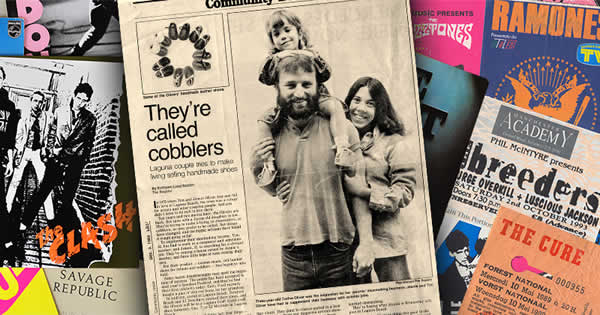
From The Orange County Register - December 3, 1985
They’re Called Cobblers
Laguna couple tries to make living selling handmade shoes
By Kathleen Lund-Seeden
In 1975 when Tim and Jeanie Oliver met and fell in love in Laguna Beach, the town was a refuge for artist and other creative people. And you didn’t have to be rich to live there.
Ten years and two moves later, the Olivers are back, this time with a 3-year-old daughter in tow. They’re trying to make a living as shoemakers, or cobblers, as they prefer to be called. But things have changed, and the hippie artisans have found it rough going so far.
To supplement their shoemaking income, Tim, 34, has had to work as a carpenter and substitute teacher, and Jeanie, 32, is searching for a clerical job. They’re renting a house owned by Jeanie’s mother, and have little hope of soon owning their own.
But their product—custom-made, soft leather shoes for infants and toddlers—has begun to take hold.
Some recent breakthroughs may spell the beginning of success. The couple has been accepted to next year’s Sawdust Festival, and they’ve had their first celebrity order. Betty Ford recently bought a pair of tiny red boots for her grandson.
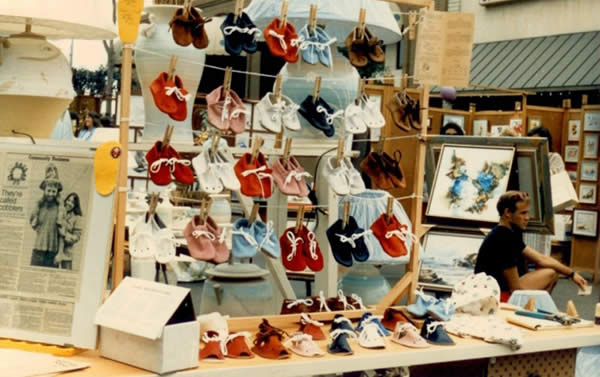
[The 1986 Sawdust Art Festival, where Softstar Shoes officially kicked off—pun intended. You can see Tim's copy of this article, newly published, on display in the lower left corner!]
In addition, stores in Laguna Beach, Newport Beach and El Toro have stocked their shoes, and the Olivers will be in a Laguna Craft Guild craft show Saturday, Dec. 7, at El Mercado in Laguna Beach.
The Olivers say they believe Softstar Shoes—handmade, flexible and made of leather and crepe rubber—eventually will take off because they’re unique and good for the feet. The couple said they’ve seen no other soft shoes—except for moccasins—on the market.
People on the street often ask where they can buy the shoes they see the Olivers and daughter Corina wearing, Mrs. Oliver said.
“They say, ‘My pediatrician told me to get soft shoes for my child, but I can’t find them,’” she said.
Soft shoes, the Olivers say, are the next best thing to bare feet—they allow young feet to grow. Stiff shoes make for an awkward “plop-plop" gait, they claim. They point to studies quoted in a Seattle hospital brochure and magazine articles showing that children wearing stiff shoes trip more often than those with soft soles.
Oliver said he feels sorry for children who wear stiff tennis shoes. He often angers store owners trying to bend conventional children’s shoes that won’t bend, his wife said.
Wearing jeans and shoulder-length hair and driving an old Datsun station wagon, the Olivers appear frozen in the flower power era. And they like the image. That look, they say, is still “in” back in Wimberley, Texas, a colony for craftsmen where the Olivers lived for three years and learned shoemaking.
They’re hoping what played in Wimberley will play in Laguna Beach.
“We thought, 'If we’re doing this good in the hills of Texas, we’ll do great in Laguna,'” said Mrs. Oliver, a native Lagunan who had longed to return.
Most of their business—usually mail-order—has come from word of mouth. While strolling through Dana Point Harbor, Betty Ford’s chef saw the shoes, ordered a pair and later mentioned it to Ford.

When the Olivers met in 1975, Jeanie was a social ecology major at UC Irvine and Tim, a Corpus Christi, Texas, transplant, was working as a carpenter. They moved to Corvallis, Ore., where he earned a teaching credential from Oregon State University. Then they moved to Texas where he taught high school photography and wood shop in Dripping Springs. Among his students was Willie Nelson’s grandson, Nelson Fowler.
The Oregon and Texas communities they lived in were colonies of craftsmen and “back-to-the-landers,” Mrs. Oliver said. Their artsy-craftsy ways apparently rubbed off on the Olivers. Soon after their daughter was born, they met a long-time craftswoman named Robin Robinette, who made children’s shoes at home. At first the Olivers’ interest was limited to shoes for Corina. But one day Robinette told them she couldn’t keep up with the shoes’ burgeoning popularity. She wanted someone to take over.
“To her it was an art, not a business,” said Oliver.
Robinette taught him to make the leather upper soles and crepe or leather bottom soles with a shoe press, and she taught Mrs. Oliver to sew the shoes and glue them together. Then she moved to Arkansas with her new husband.
A short time later, Oliver quit his job, they sold their house and moved to Laguna Beach. With a $6,000 investment in a hand press, a sewing machine, brochures and materials, they set up shop in the back yard of their new Laguna Beach home.
After a bit of experimenting, searching for equipment and leather in downtown Las Angeles and sales to friends “back home” in Texas in September, they began selling shoes, boots and sandals in children’s sizes 1 through 8. Prices start at $11 for shoes and $19 for boots. Mail-order customers send in a tracing of their child’s foot for a proper fit.
So far the Olivers have made about 200 shoes. They say they can make about 20 shoes a day if they push it.
“Now we just need exposure,” said Mrs. Oliver.
“We don’t’ want to get rich,” her husband added. “We just want to live off it.”
Related Posts:
- The History of Softstar: 30 Years of Shoemaking [INFOGRAPHIC]
- Elf Roots: The Early Days of Softstar Shoes
- Blast From the Past: A Shoe for All Generations

Martin is a lifelong runner who began wearing minimalist shoes over 10 years ago when he found they alleviated his chronic foot pain, which eventually disappeared completely. He further studied proper running form through a series of workshops taught by the inventor of Correct Toes Toe Spacers, Dr. Ray McClanahan DPM. Martin has collaborated with several health care professionals to collect and share peer-reviewed studies that show the benefits of minimalist footwear. In his personal life, Martin loves living in the Pacific Northwest because it allows him to enjoy a variety of outdoor activities year-round, including hiking, cycling, rock climbing, surfing and snowboarding.
1 Comment