
The Case for Minimalism: 2-Year Case Study Suggests Minimalist Shoes Lead to Stronger Arches
As a bonafide shoe elf, I'm usually eager to tout the benefits of minimalist shoes and barefoot running, especially after my experience overcoming plantar fasciitis simply by switching to Soft Stars. I promise I make an effort to stay respectful and not pushy, and I usually don't bring it up unless I'm asked about my shoes (which happens often). When the subject does come up, there is something that always intrigues me. Whenever I start to explain to people why my shoes don't have any cushioning or arch support, I most often hear this immediate response:
"I can't wear shoes like that—I need arch support because I have flat feet."
Ironically, the second most common response is this:
"I can't wear shoes like that—I need arch support because I have high arches."
At the very least, I think this suggests there is a bit of confusion regarding arch supports and what they do for/to your feet.

Archetypes (get it... archetypes? ha!)
The minimalist and barefoot running community tends to believe that round arches are a sign of strong feet (although sometimes high arch muscles can be too tight). Flat feet, on the other hand, are a sign of arches that have been weakened from arch supports, which act like a crutch and atrophies arch muscles by preventing them from flexing and strengthening properly. These same theories conclude that taking away arch supports will strengthen feet and lead to higher, rounder arches (for more details on this theory, check out our Mighty Arch blog series).
In the wake of the recent Vibram lawsuit, many critics are eager to denounce all the perceived health benefits of minimalist shoes as nothing more than hogwash and old wives tales. We're shoemakers, not doctors, so we can't make any medical claims ourselves, but I think it's worth pointing out that while Vibram's healthy claims may not have been proven, they also haven't been disproven. The jury is still out on the benefits of minimalism and new research is slowly rolling in. Which leads us to Dr. Nick...
Dr. Nick Campitelli (commonly known as just Dr. Nick) is a podiatrist and long distance runner in Akron, Ohio. Dr. Nick has his own blog, which targets runners specifically to educate them on proper foot health. He is also a big fan of barefoot running and minimalist shoes and treating foot ailments naturally by correcting running and walking form. In a recent post, Dr. Nick showed the results of a two-year study in which he documented the changes in a patient's arch height and degree of pronation and supination as she transitioned to minimalist footwear. The results were very noticeable, and they gave a few points to the case for minimalist shoes. We're excited to share with you his article and photos:
Two Year Long Case Study Demonstrating an Increase in Arch Height From Running in Minimalist Shoes
by Dr. Nick Campitelli
The debate is ongoing as to the use of minimalist shoes and running barefoot. Few studies have been done and there are so many variables to control which makes these existing studies practically irrelevant. To see the true effects of what happens to our foot by removing the external support from a traditional motion control running shoe, it takes time. Years actually. I would like to share an example of a runner who had abandoned her rigid orthotics and motion control ASICS running shoes and began wearing minimalist shoes. The New Balance Minimus with a zero drop to be exact.

She was 34 two and a half years ago and had flexible flat feet, a valgus position of the calcaneus (the heel bone angles inward when observing from behind), and a valgus knee deformity (knock knees). Her symptoms consisted of knee pain as well as frequent lower back pain. She was wearing custom rigid orthotics which were implemented to realign her arch and heel bone. We had her follow my transition protocol of removing the orthotics for the first part of a run and then replacing them for the remainder. As an example, for a three mile run the orthotics would be removed for a half mile then placed back in for the remaining 2.5 miles. This was gradually increased each week until she was able to comfortably run without them. The same was done for the motion control shoes but in a slower manner. I advise using the 10% rule. Each week mileage is increased wearing the minimalist shoe by 10%. Again, the new shoe is worn first and the run is completed in the traditional shoe. This can sometimes take up to 6-8 weeks or more depending on the level of running a person is doing before the complete transition is made. Many times I tell the patient it takes 3 months to safely transition. Remember, three months can be a blink of an eye in the whole scheme of things as many patients present me with years of pain.
Of course what I am about to share is anecdotal. I realize that. However, this is a two year example of the changes that can occur to an adults foot that results from strengthening the postural muscles of the foot, specifically the abdcutor hallucis muscle. This is not the direct result of simply wearing a minimalist shoe. This is the result of what happens when you stress the foot and let it work the way it was intended to and become stronger. It has not relied on external support and adapted to the stresses placed upon it. The studies that are currently being published share weeks or sometimes a few months of results. This is a 2 year example. My colleagues and I are also submitting for publication a 6 month study that will show objective results of a similar finding. Let’s see what happens to the foot when you do not rely on orthotics and motion control shoes.
Heel Alignment
The below pictures shows the improvement in the alignment if the heel bone known as the calcaneous. You can see in 2012 the calcaneous was more everted or slanted inward as a result of a weak abductor hallucis muscle which leads to a collapse of the medial longitudinal arch. In 2014 the calcaneous is now more rectus or vertically orientated. This is a result of a stronger abductor hallucis muscle pulling and shortening between the great toe and heel bone which improves the arch and straightens the heel or calcaneous bone.

“Outward Toes”
Next is an example of what clinicians refer to as the “too many toes sign”. When viewing the foot again from a posterior or “behind” view we can see in 2012 there were more toes visible on the outside of the foot demonstrating a weak or collapsing arch. In the 2014 image you can see the lateral or outside column of the foot has realigned and the toes are no longer visible.

The Arch
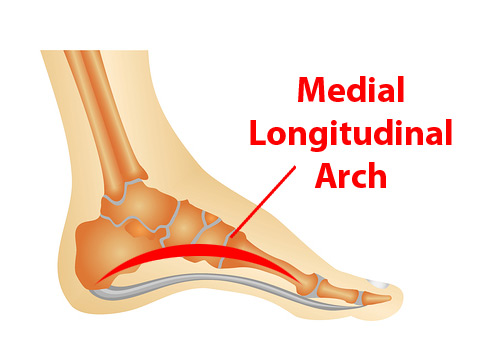
Finally we examine the medial longtitudinal arch. This is the arch of the foot that most people refer to when they say they have a “flat foot”. To simplify, the arch height will be absent or pressed against the floor with a flat foot or in someone with weak foot musculature. Here we can see in 2012 there was very little if any arch height present on the inside of the foot. After 2 and a half years of strengthening the foot and lower extremity musculature in 2014 there is now an increase in arch height.

In summary, this is anecdotal, but these are the changes we are seeing in runners who have transitioned to less of a shoe. These results were seen and described by many in the barefoot running community and now we are exponentially increasing numbers as runners are switching to minimalist type shoes. This is just one documented example of many with photographic evidence that I have seen in my practice. Why is this so significant? Because this is proof that running in a minimalist shoe can strengthen intrinsic foot musculature which can then change the shape of the foot and arch over time. I hope to soon have more similar objective results published!!
Related Posts:
- A Minimalist Miracle? Correct Toes May Treat and Cure Foot Pain Without Surgery
- Are High Heels Giving You Hammer Toes? Tips for Prevention and Treatment
- Wikler's Quest for Healthy Children's Feet
 Dr. Nick Campitelli is a podiatrist in Akron, Ohio specializing in foot and ankle surgery with an interest and enthusiasm for running as well as helping runners with injuries. For the past several years he has been treating running injuries in patients by fixing their form and transitioning them to minimalist shoes. Having treated runners with all types of injuries through conservative measures with orthotics and shoe gear changes to reconstructive foot and ankle surgery, Dr. Campitelli has brought what works best and is most current to his practice as well as the Akron and Cleveland running communities.
You can follow his foot health and running blog at www.drnicksrunningblog.com.

Martin is a lifelong runner who began wearing minimalist shoes over 10 years ago when he found they alleviated his chronic foot pain, which eventually disappeared completely. He further studied proper running form through a series of workshops taught by the inventor of Correct Toes Toe Spacers, Dr. Ray McClanahan DPM. Martin has collaborated with several health care professionals to collect and share peer-reviewed studies that show the benefits of minimalist footwear. In his personal life, Martin loves living in the Pacific Northwest because it allows him to enjoy a variety of outdoor activities year-round, including hiking, cycling, rock climbing, surfing and snowboarding.